Viral Government budget Stories Right Now: 12 Headlines Americans Are Reading
What are Americans reading and sharing right now? This guide to viral government budget stories gathers real headlines from news outlets, credits every source by name, and explains how to read each one with a clear head. It is a starting point, not a replacement for the original reporting.
Please treat this page as a map rather than the territory. The headlines are real and linked, but each one is only a summary of a longer report. Details can change as outlets update their coverage, so the original source is always the best place to check the latest facts.

Where These Headlines Come From
Headlines in this roundup come from public news feeds covering a wide range of outlets. Duplicates are removed, each item keeps its source name and publication date, and every headline is linked to the original article so nothing here depends on trust in this page alone.
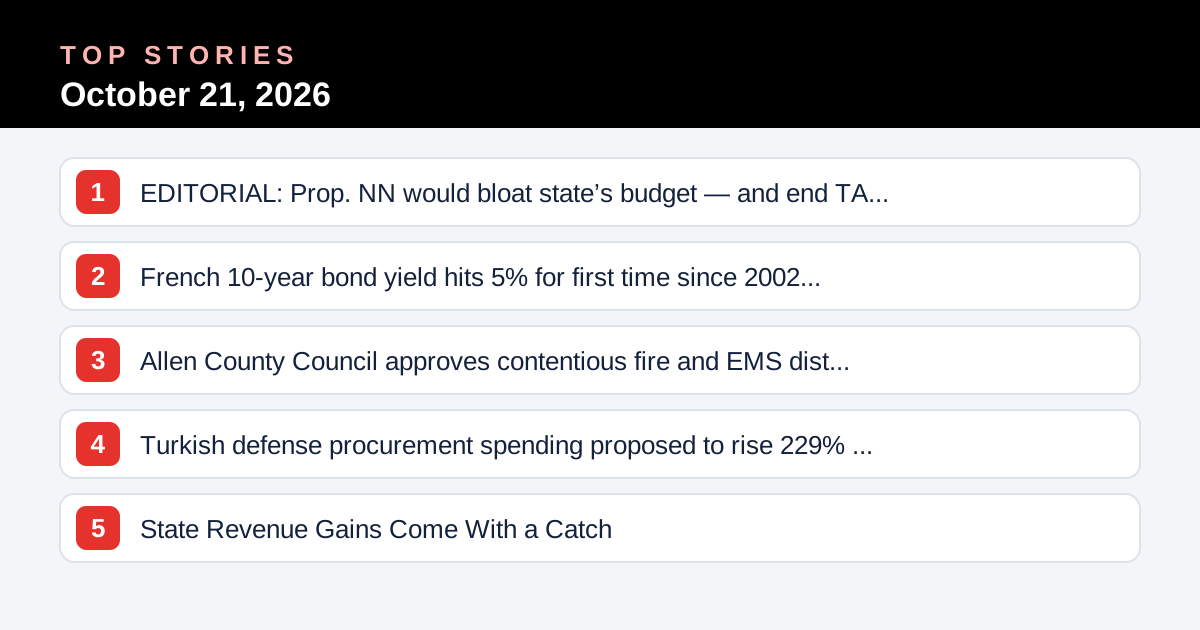
EDITORIAL: Prop. NN would bloat state’s budget — and end TABOR refunds
On Oct 21, 2026, Colorado Springs Gazette published a report headlined "EDITORIAL: Prop. NN would bloat state’s budget — and end TABOR refunds". Headlines like this spread quickly because readers often share them before opening the full article. Checking the publication date matters, because older stories sometimes resurface and look new. We include it here because it was widely reported, not because we have verified every detail.
Source: Colorado Springs Gazette, Oct 21, 2026
French 10-year bond yield hits 5% for first time since 2002 amid unrest
On Oct 21, 2026, CNBC published a report headlined "French 10-year bond yield hits 5% for first time since 2002 amid unrest". Stories that touch everyday life tend to be passed along fast, even when only a few details are known. Readers who want details should follow the link, because this summary does not replace the original reporting. This is one of the stories people have been talking about, and the source link below leads to the full report.
Source: CNBC, Oct 21, 2026
Allen County Council approves contentious fire and EMS district budget
The Journal Gazette reported this story on Oct 19, 2026 under the headline "Allen County Council approves contentious fire and EMS district budget". When a story trends, the first version many people see is a screenshot of the headline rather than the article itself. Checking the publication date matters, because older stories sometimes resurface and look new. The full article is the place to find names, numbers, and quotes, none of which are repeated here.
Source: The Journal Gazette, Oct 19, 2026
Turkish defense procurement spending proposed to rise 229% in 2027
Under the headline "Turkish defense procurement spending proposed to rise 229% in 2027", Breaking Defense covered this story on Oct 20, 2026. Interest in a story often grows when several outlets cover it at once, which makes it feel bigger than any single report. Checking the publication date matters, because older stories sometimes resurface and look new. The full article is the place to find names, numbers, and quotes, none of which are repeated here.
Source: Breaking Defense, Oct 20, 2026
State Revenue Gains Come With a Catch
Under the headline "State Revenue Gains Come With a Catch", Conduit Street Blog covered this story on Oct 21, 2026. Headlines like this spread quickly because readers often share them before opening the full article. Updates are common as new information arrives, so the original page may now say more than the headline did.
Source: Conduit Street Blog, Oct 21, 2026
Why has Kentucky State University faced budget troubles? The answer is obvious | Opinion
Lexington Herald Leader ran this item on Oct 21, 2026 with the headline "Why has Kentucky State University faced budget troubles? The answer is obvious | Opinion". Short headlines are built to be understood at a glance, which is why they travel so well on social media. A good habit is to read past the first paragraph and look for named sources and clear dates.
Source: Lexington Herald Leader, Oct 21, 2026
Want a receipt for your Florida state taxes? This new, free ‘budget explorer’ does that and much more
Florida Politics reported this story on Oct 20, 2026 under the headline "Want a receipt for your Florida state taxes? This new, free ‘budget explorer’ does that and much more". Short headlines are built to be understood at a glance, which is why they travel so well on social media. If the story matters to you, compare it with a second outlet to see whether the main points match. We include it here because it was widely reported, not because we have verified every detail.
Source: Florida Politics, Oct 20, 2026
DMV office returns to Tabor City, House majority leader's hometown. What to know
The headline "DMV office returns to Tabor City, House majority leader's hometown. What to know" appeared on Oct 21, 2026 from News & Observer. Interest in a story often grows when several outlets cover it at once, which makes it feel bigger than any single report. If the story matters to you, compare it with a second outlet to see whether the main points match.
Source: News & Observer, Oct 21, 2026
Missouri auditor candidates split over how office should con...
Wayne County Journal Banner ran this item on Oct 19, 2026 with the headline "Missouri auditor candidates split over how office should con...". A headline can only hold a fraction of a story, so the full report usually contains context that a headline leaves out. Checking the publication date matters, because older stories sometimes resurface and look new.
Source: Wayne County Journal Banner, Oct 19, 2026
The Bill for Trumpism Comes Due
The headline "The Bill for Trumpism Comes Due" appeared on Oct 21, 2026 from The Atlantic. A headline can only hold a fraction of a story, so the full report usually contains context that a headline leaves out. If the story matters to you, compare it with a second outlet to see whether the main points match.
Source: The Atlantic, Oct 21, 2026
South Africa Tightens Budget Rules as Government Debt Stabilizes
Bloomberg.com reported this story on Oct 21, 2026 under the headline "South Africa Tightens Budget Rules as Government Debt Stabilizes". When a story trends, the first version many people see is a screenshot of the headline rather than the article itself. Readers who want details should follow the link, because this summary does not replace the original reporting.
Source: Bloomberg.com, Oct 21, 2026
County Budget Hearing is Oct. 27
On Oct 20, 2026, upsonbeacon.com published a report headlined "County Budget Hearing is Oct. 27". Interest in a story often grows when several outlets cover it at once, which makes it feel bigger than any single report. Readers who want details should follow the link, because this summary does not replace the original reporting.
Source: upsonbeacon.com, Oct 20, 2026
Local Stories That Become National News
Many stories that trend nationally begin as local reports from a small newsroom. A video, a court filing, or a community event catches attention, gets shared widely, and is then picked up by larger outlets. Local reporters often have the best details, so the original local article is worth reading when you can find it. National summaries sometimes repeat the key points but skip the background that residents know well.
The Role of Social Media in Spreading News
Social platforms reward content that earns quick reactions, so dramatic headlines often travel farther than quiet, detailed ones. A story can reach millions of people before anyone has read the whole thing. Algorithms also show readers more of what they already engage with, which can make a topic feel larger than it is. Stepping outside your feed and visiting news sites directly is a simple way to get a more balanced picture.
How to Check a Headline Before You Share It
Start with the outlet. Is it a known publication with a named newsroom and a way to contact it? Then look at the date, the author, and the sources the article quotes. Read beyond the headline, because headlines are written to attract attention and can leave out important limits. If something sounds surprising, search for the same story on another outlet. When several independent reports agree on the main facts, that is a good sign. When only one obscure page carries it, wait before sharing.
Headlines Versus the Full Story
A headline is a promise of a story, not the story. It has to be short, so it compresses events into a handful of words and often drops qualifiers such as who said something, what is still unknown, or what has changed since. Reading the full article usually shows more careful wording than the headline suggests. This is why the links in this roundup matter: they lead to the complete reports where those details live.
Opinion Pieces Versus News Reports
News reports aim to describe what happened, while opinion pieces argue for a point of view. Both can be valuable, but they should not be mixed up. Reputable outlets label opinion and analysis clearly. When a headline sounds more like a verdict than a description, check whether the article is an opinion column before treating its claims as settled facts.
How Publishing Times Affect What You See
The United States spans several time zones, so a story posted in the morning on the East Coast may reach the West Coast before anyone there has woken up. Outlets also schedule articles around peak reading hours, and platforms show posts at different moments to different people. As a result, two readers can see the same story at very different points in its life. Checking the publication date and time on the original page helps you understand how current a report really is.
Reading News Calmly in a Busy Feed
It is easy to feel that every trending story needs an immediate reaction. In practice, most stories become clearer after a few hours, when more details are confirmed. Choosing a few trusted outlets, setting aside time to read, and avoiding the urge to share half-read headlines can make the news feel less overwhelming. A short pause before sharing also helps limit the spread of mistakes.
Why Some News Stories Go Viral
News goes viral when it is easy to understand, easy to share, and connected to something people already care about. Strong emotions such as surprise, worry, or pride make readers more likely to pass a story along. Timing matters too: a story that lands during a busy news day may be overlooked, while the same story on a quiet day can dominate every feed. None of this says whether a story is accurate, which is why careful readers separate how popular a headline is from how reliable its details are.
Understanding Anonymous Sources
Sometimes reporters rely on people who cannot be named, for example because they fear losing a job or facing retaliation. Responsible outlets explain why a source is unnamed and try to confirm information with more than one person or document. When you read a story built on unnamed sources, look for signs of that care, such as a description of the source's position and a note on how the claim was checked. Reports that give no explanation at all deserve extra caution.
The Bottom Line on Today's Viral Government budget Stories
These stories are a snapshot of what has been widely reported. Because details change, the linked articles are the best place for accurate and current information. Check back for new roundups as other stories rise through the news. Think before you click. Small details often change the meaning of a headline. Good habits make you a better reader. Facts first. Trusted reporting takes time, so be patient with developing stories. Different readers care about different stories, and that is normal. Look for named sources and clear dates.
This roundup is compiled automatically from the linked news reports. Details may be incomplete or change; please read the original sources.