Viral Economic stories Stories Right Now: 8 Headlines Americans Are Reading
Viral economic stories stories rarely stay in one place. A single headline can move from a local website to national television and then to millions of screens within hours. Below is a roundup of recent headlines from across the USA, each linked to the original report so you can read the full story yourself.
A note on how this page works: the headlines and outlet names below come directly from public news feeds. We do not add details that the reports do not state, and we do not claim to know more than the original journalists. When you want facts, names, numbers, or quotes, open the linked report.

Where These Headlines Come From
Headlines in this roundup come from public news feeds covering a wide range of outlets. Duplicates are removed, each item keeps its source name and publication date, and every headline is linked to the original article so nothing here depends on trust in this page alone.
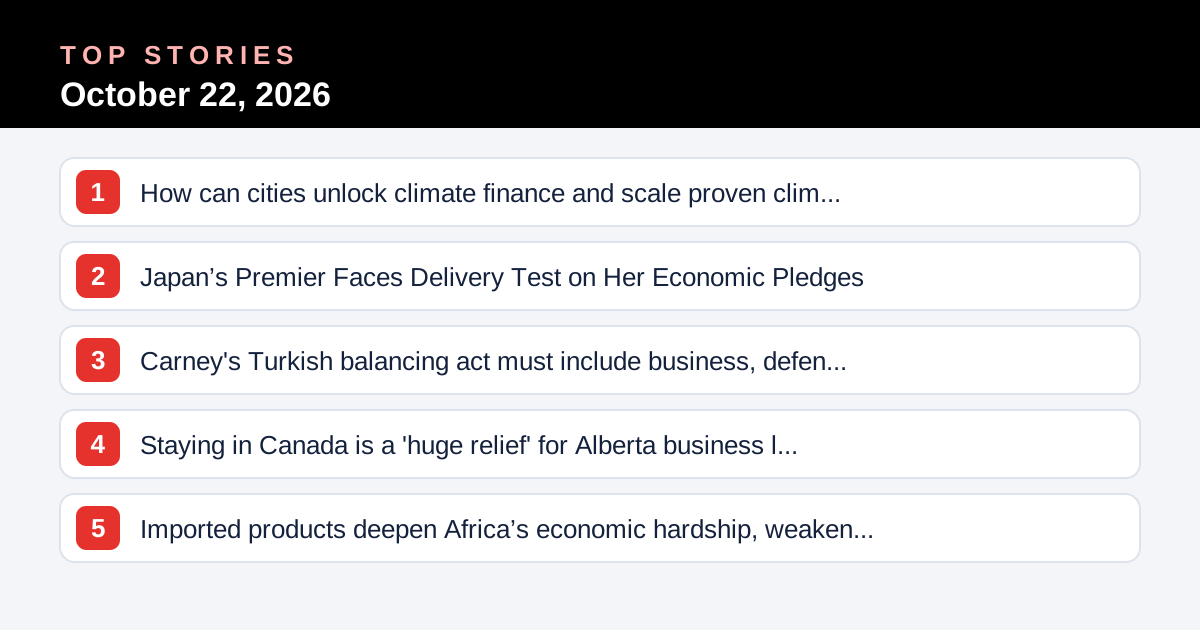
How can cities unlock climate finance and scale proven climate solutions?
World Economic Forum ran this item on Oct 21, 2026 with the headline "How can cities unlock climate finance and scale proven climate solutions?". A headline can only hold a fraction of a story, so the full report usually contains context that a headline leaves out. Readers who want details should follow the link, because this summary does not replace the original reporting.
Source: World Economic Forum, Oct 21, 2026
Japan’s Premier Faces Delivery Test on Her Economic Pledges
On Oct 21, 2026, Bloomberg.com published a report headlined "Japan’s Premier Faces Delivery Test on Her Economic Pledges". Interest in a story often grows when several outlets cover it at once, which makes it feel bigger than any single report. Checking the publication date matters, because older stories sometimes resurface and look new. We include it here because it was widely reported, not because we have verified every detail.
Source: Bloomberg.com, Oct 21, 2026
Carney's Turkish balancing act must include business, defence and human rights
The headline "Carney's Turkish balancing act must include business, defence and human rights" appeared on Oct 21, 2026 from CBC. Headlines like this spread quickly because readers often share them before opening the full article. If the story matters to you, compare it with a second outlet to see whether the main points match. This is one of the stories people have been talking about, and the source link below leads to the full report.
Source: CBC, Oct 21, 2026
Staying in Canada is a 'huge relief' for Alberta business leaders
CBC reported this story on Oct 20, 2026 under the headline "Staying in Canada is a 'huge relief' for Alberta business leaders". Short headlines are built to be understood at a glance, which is why they travel so well on social media. Readers who want details should follow the link, because this summary does not replace the original reporting. The full article is the place to find names, numbers, and quotes, none of which are repeated here.
Source: CBC, Oct 20, 2026
Imported products deepen Africa’s economic hardship, weaken local industries —Dangote
On Oct 22, 2026, Ripples Nigeria published a report headlined "Imported products deepen Africa’s economic hardship, weaken local industries —Dangote". Headlines like this spread quickly because readers often share them before opening the full article. Readers who want details should follow the link, because this summary does not replace the original reporting.
Source: Ripples Nigeria, Oct 22, 2026
CILT Seeks Integrated Transport System To Drive Economic Growth
On Oct 22, 2026, News Agency of Nigeria published a report headlined "CILT Seeks Integrated Transport System To Drive Economic Growth". When a story trends, the first version many people see is a screenshot of the headline rather than the article itself. Updates are common as new information arrives, so the original page may now say more than the headline did. This is one of the stories people have been talking about, and the source link below leads to the full report.
Source: News Agency of Nigeria, Oct 22, 2026
Jersey minister says economic value makes Heathrow worth subsidising
Under the headline "Jersey minister says economic value makes Heathrow worth subsidising", Guernsey Press covered this story on Oct 21, 2026. Headlines like this spread quickly because readers often share them before opening the full article. Readers who want details should follow the link, because this summary does not replace the original reporting.
Source: Guernsey Press, Oct 21, 2026
Trump emerges as ‘prime suspect’ in economic mystery stumping experts: economist
Raw Story reported this story on Oct 21, 2026 under the headline "Trump emerges as ‘prime suspect’ in economic mystery stumping experts: economist". Short headlines are built to be understood at a glance, which is why they travel so well on social media. Before sharing, it helps to open the linked report and check who wrote it and when it was published. This is one of the stories people have been talking about, and the source link below leads to the full report.
Source: Raw Story, Oct 21, 2026
Why Some News Stories Go Viral
News goes viral when it is easy to understand, easy to share, and connected to something people already care about. Strong emotions such as surprise, worry, or pride make readers more likely to pass a story along. Timing matters too: a story that lands during a busy news day may be overlooked, while the same story on a quiet day can dominate every feed. None of this says whether a story is accurate, which is why careful readers separate how popular a headline is from how reliable its details are.
Local Stories That Become National News
Many stories that trend nationally begin as local reports from a small newsroom. A video, a court filing, or a community event catches attention, gets shared widely, and is then picked up by larger outlets. Local reporters often have the best details, so the original local article is worth reading when you can find it. National summaries sometimes repeat the key points but skip the background that residents know well.
Understanding Anonymous Sources
Sometimes reporters rely on people who cannot be named, for example because they fear losing a job or facing retaliation. Responsible outlets explain why a source is unnamed and try to confirm information with more than one person or document. When you read a story built on unnamed sources, look for signs of that care, such as a description of the source's position and a note on how the claim was checked. Reports that give no explanation at all deserve extra caution.
Spotting Misleading Images and Clips
Photos and short videos spread faster than text, and they are also easy to reuse out of context. An image that appears to show a current event may be older, from another place, or edited. Reverse image search tools and the original publisher's page can help confirm where a picture came from. If a striking image has no clear source, treat it with caution until a reliable outlet confirms it.
Why Different Outlets Cover the Same Story Differently
Two outlets can report the same event and still emphasize different details. One may lead with the people involved, another with the numbers, a third with the reaction. These choices reflect audience, space, and editorial judgment. Reading more than one report is a practical way to see the full range of facts, and it makes it easier to notice when something is missing from a single account.
Why Context Matters More Than Speed
Being first to share a story is rarely as useful as being right. Context, such as what happened before, who is affected, and what is still unknown, is what turns a headline into understanding. Taking a few extra minutes to read the full report and a second source usually gives a far clearer picture than the first version that reaches your feed.
Headlines Versus the Full Story
A headline is a promise of a story, not the story. It has to be short, so it compresses events into a handful of words and often drops qualifiers such as who said something, what is still unknown, or what has changed since. Reading the full article usually shows more careful wording than the headline suggests. This is why the links in this roundup matter: they lead to the complete reports where those details live.
Sources, Dates, and Named Reporters
Three small details tell you a lot about a news article: who published it, when, and who wrote it. A named reporter, a visible date, and links to original documents or statements make an article easier to check. When those details are missing, it is harder to know how much weight to give the story. The reports linked in this roundup show the outlet and date so you can make that judgment yourself.
What a Trending Topic Does and Does Not Tell You
A trending label means many people are talking about something right now. It does not mean the topic is important, true, or new. Trends can be driven by a single post, a joke, or coordinated sharing. Use trends as a reason to look closer, then rely on the reporting itself, with named sources and clear dates, to understand what actually happened.
How to Check a Headline Before You Share It
Start with the outlet. Is it a known publication with a named newsroom and a way to contact it? Then look at the date, the author, and the sources the article quotes. Read beyond the headline, because headlines are written to attract attention and can leave out important limits. If something sounds surprising, search for the same story on another outlet. When several independent reports agree on the main facts, that is a good sign. When only one obscure page carries it, wait before sharing.
Building a Balanced News Routine
A steady routine beats constant checking. Choose a small set of outlets with different strengths, such as a national newspaper, a wire service, and a local source. Read them at set times instead of reacting to every alert. Add an occasional source from outside your usual preferences to see how other readers view the same events. A balanced routine keeps you informed while leaving room for the rest of your day.
Corrections and Retractions: Signs of a Healthy Newsroom
Every newsroom makes mistakes, and what matters is how they are handled. Reliable outlets publish clear corrections, explain what changed, and keep the original page available with a note. If an article has been quietly changed with no explanation, or an error is repeated across many pages, that can be a warning sign. When you see a visible corrections policy, it shows that the outlet is willing to be held accountable by its readers.
Why Numbers in Headlines Need Context
A number in a headline can sound precise while hiding important details. A figure may refer to a single place, a short period, or a particular definition that differs from what readers assume. Percentages can look large when the starting number is small, and totals can look small when spread across many people. The article itself usually explains what is being counted and how, which is why it is worth reading beyond the first line.
What to Remember About Viral Economic stories News
These stories are a snapshot of what has been widely reported. Because details change, the linked articles are the best place for accurate and current information. Check back for new roundups as other stories rise through the news. Follow outlets that publish corrections. Different readers care about different stories, and that is normal. Keep a list of sources you trust. Bookmark the stories you want to follow. Notice how a story makes you feel, then check the facts. A little skepticism goes a long way. Share the link, not just the screenshot.
This roundup is compiled automatically from the linked news reports. Details may be incomplete or change; please read the original sources.


